
You paid $40 for that lead. Maybe $60. Maybe more if you’re on Premier Agent in a competitive ZIP. You got the notification, you called when you could and they didn’t answer. You then left a voicemail, sent a text, and waited.
Nothing.
Three days later, you check Zillow and see they’re now working with another agent. It’s the agent who responded in 90 seconds.
If this happens to you regularly, you have a response problem. And the good news is it’s fixable, without hiring an ISA, without working 14-hour days, and without quitting on Zillow entirely (which a lot of agents threaten but few can actually afford to do).
This guide covers what actually works to follow up with Zillow leads in 2026, including the exact response times that close, the scripts that get replies, the cadence that converts, and the part most agents skip, what to do when you physically can’t be at your phone.
TL;DR — The 60-Second Version
- You have about 5 minutes before a Zillow lead becomes 80% less likely to convert. Most agents miss this window.
- Leads from Zillow typically fill out 3–5 forms. Whoever calls first wins about half the time. Second call is a distant second.
- First contact should be a phone call, not a text or email. A text or email can follow if the call misses.
- If the lead doesn’t answer, follow up with a text within 2 minutes — referencing the missed call and the property they asked about.
- The follow-up cadence that converts is calls + texts spread across Days 1, 2, 3, 7, and 14. Mix call and text. Vary timing.
- Most agents physically cannot hit a 5-minute response window while showing houses, on other calls, or asleep. This is where AI lead response tools come in.
If you want the long version with scripts, keep reading.
Why Zillow Leads Ghost You (The Actual Reasons)
The agent forums are full of complaints that “Zillow leads are trash.” This is mostly wrong, though Zillow’s lead quality has real issues. The deeper reason most Zillow leads ghost is that by the time you call them, they’re not a lead anymore. They’re already someone else’s client.
Here’s what’s actually happening on the lead’s side of the screen:
A buyer or seller browses Zillow, finds a property they’re curious about, and clicks “Request more info” or “Contact agent.” That single click sends their info to multiple agents on Premier Agent, often three, sometimes more, depending on your ZIP and tier. The buyer doesn’t know this. They think they contacted one agent about one property.
Within the next 30 seconds, the phone starts ringing. If the first agent reaches them, that agent gets the conversation, the showing request, and almost always the relationship. The next two or three agents call into a voicemail box that’s already going to be ignored.
A 2011 Harvard Business Review study by Oldroyd, McElheran and Elkington audited 2,241 U.S. companies and analyzed 1.25 million leads. The core finding: companies that tried to contact a lead within an hour were nearly 7 times more likely to have a meaningful conversation with a decision-maker than companies that tried even an hour later, and more than 60 times more likely than companies that waited 24 hours or more. Oldroyd’s earlier Lead Response Management study (2007, with InsideSales.com) showed the 5-minute window matters even more inside that hour: contacting a lead within 5 minutes made you 21 times more likely to qualify them than contacting at 30 minutes.
Zillow leads aren’t different from other web leads in this respect. They’re worse, because the lead is being simultaneously contacted by competitors inside that same window.
So when an agent says “Zillow leads don’t respond,” what they’re usually describing is: Zillow leads don’t respond to me because someone else got to them first.
The fix isn’t a better script or better leads. The fix is response time.
Not every Zillow lead reaches you the same way. Zillow puts connections through to you on a live call, while direct contacts and nurture leads wait in your Zillow inbox until you act. Here’s how each kind of Zillow lead reaches you, and how to get them called.
The 5-Minute Window That Decides Everything
Let’s get specific about what “fast response” actually means.
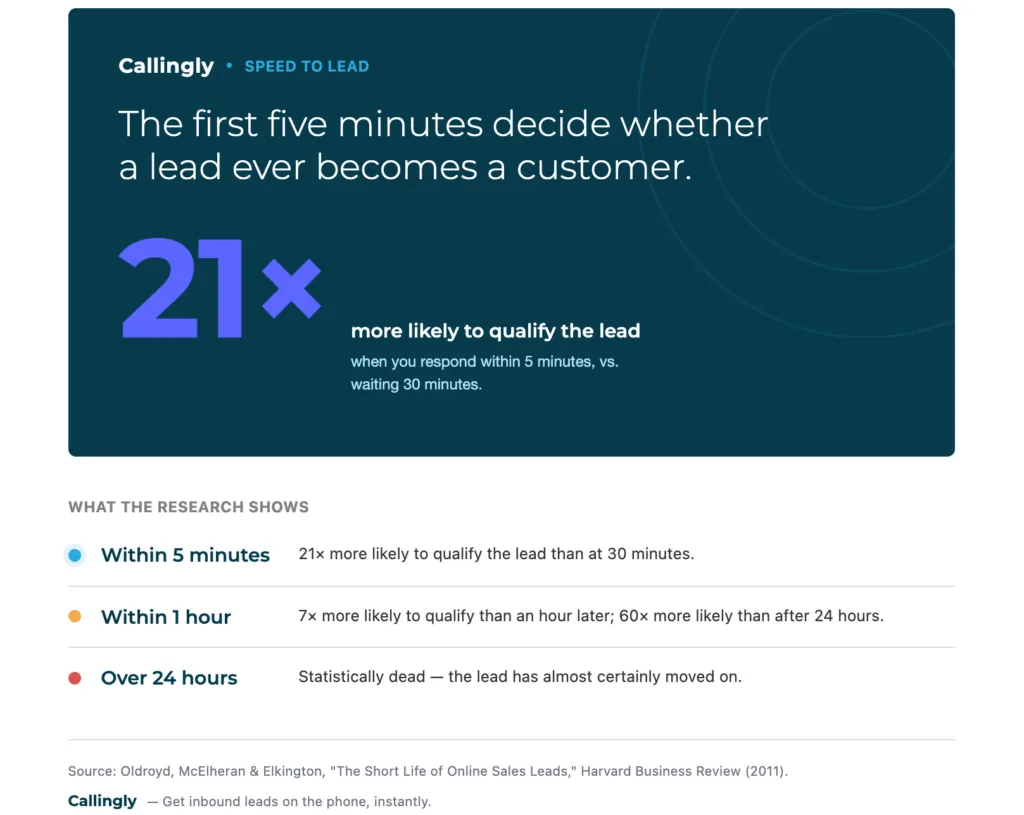 What this means in practice: the difference between calling a lead at 30 seconds and 5 minutes is bigger than the difference between calling at 5 minutes and never calling at all. It’s not linear. Speed isn’t a “nice to have,” it’s almost the entire game.
For real estate specifically, the gap is even more brutal because of how Zillow distributes leads. If a competing agent on the same ZIP gets a call to the lead in 90 seconds and you call in 8 minutes, the lead may already have a Saturday showing scheduled with the other agent before you dial.
The implication: every system you have for following up with Zillow leads, your CRM, your auto-texter, your ISA, your phone notifications, needs to be measured by one thing. Does this get me on the phone with a real human in under 5 minutes, every time, day or night?
If the honest answer is no, the rest of this guide will help you build the follow-up sequence that wins back the leads that slip past the 5-minute window. There are real conversions hiding in there too, just fewer.
The First Call: What to Actually Say
When you do reach a Zillow lead live on the first attempt, the call itself matters less than agents think. They wanted information. You’re calling with information. Most of the work is done.
A few things that work, learned from listening to thousands of real first-contact calls:
Open with the property they asked about, not yourself. Agents instinctively introduce themselves first (“Hi this is Jen with XYZ Realty…”). Buyers don’t care about you yet. They care about the house.
Better opening: “Hi, is this Sarah? I’m Jen — I’m calling about the home you looked at on Mockingbird Lane. Is now a good time?”
This does three things: confirms you’re talking to the right person, references the property they actually expressed interest in (proves you’re not a random spam call), and gives them a graceful out if they’re driving.
Ask the qualifying questions early, but not all of them. You need to know:
- Are they pre-approved? (If buying)
- What’s their timeline? (Now, 3 months, 6+?)
- Are they working with another agent? (Critical — and most agents don’t ask)
- What got their attention about this property specifically?
The “working with another agent” question is one most agents avoid because it feels confrontational. Don’t avoid it. Ask politely — “Quick question — are you already working with an agent, or are you still in the early stages of looking?” Knowing the answer changes how you handle the next 14 days. If they have an agent, you’re farming a referral or staying in touch for the next purchase, not pushing for a showing.
Don’t push for the showing on the first call. Counterintuitive. Most sales training says “always be closing.” For real estate inbound, you’re better off offering value first — “I can pull up the disclosures on that property and send them over today, want me to email those?” — and letting the showing request come from them. Pushing for a showing on minute one comes across like Glengarry Glen Ross. Letting them lead positions you as their resource.
End by setting the next touchpoint, every time. Never just hang up. Always: “I’ll send you those disclosures by 3 today, and let’s hop on a call Thursday to talk through your top three homes — sound good?” Next-step commitment dramatically reduces ghosting.
If They Don’t Answer (The Text Within 2 Minutes)
Most Zillow leads will go to voicemail on the first call. This is normal. Almost nobody answers numbers they don’t recognize, even when they just filled out a form 30 seconds ago.
The play here is fast: send a text within 2 minutes of the missed call.
Texts to recently-acquired leads have wildly higher open rates than emails, somewhere between 95–98% within 5 minutes of being sent, vs. 20% for email within 24 hours. The lead is also primed: they just filled out a form, just got a missed call, and a text with the same name as the missed call clicks the puzzle pieces together.
A text template that works:
Hi Sarah — Jen here, I just tried to call about the home on Mockingbird Ln you looked at. Happy to send you the disclosures and answer any questions. What’s the best time to chat today?
Why this template:
- Uses their first name (you got it from the Zillow form)
- Identifies who you are without a sales pitch
- References the specific property — proves you’re real, not a spam blast
- Offers value (disclosures) before asking for anything
- Closes with an easy answer (“today” — they just say morning or afternoon)
- Under 250 characters — fits in a single notification preview on iOS
Things to avoid in the first text:
- Don’t say “I see you’re interested in real estate” (generic, automated-sounding)
- Don’t include a link in the first text (triggers SMS spam filters and looks like marketing)
- Don’t ask “Are you still looking?” — it’s a yes/no question that’s easy to ignore
- Don’t send multiple texts back-to-back (one text per touchpoint, always)
If they reply, you’re back in business. Move the conversation to a call as quickly as possible — text is great for opening doors, but you can’t qualify a lead over SMS.
The 14-Day Follow-Up Sequence (Day By Day)
When the first call and text don’t get a reply, you’re in the long game. The next 14 days determine whether this lead converts, ghosts entirely, or eventually circles back when they’re ready.
Here’s the cadence that consistently produces the best reply rates across real estate inbound:
Day 1 (Lead arrival)
- Within 5 minutes: First call
- Within 2 minutes of missed call: First text
- 3–4 hours later: Second call (if you got nothing)
Day 2
- Mid-morning: Second text — reference the property and offer something specific
Sarah — circling back on the Mockingbird Ln home. There are two similar listings on the same street that just came on the market. Want me to send the details?
Day 3
- Late afternoon: Third call attempt
- If voicemail, leave one (script below)
Day 7
- Mid-morning: Email with property comparables or market data
- Same day, evening: SMS check-in — “Sarah, are you still actively looking, or has the timing shifted?”
Day 14
- The graceful out: One final text
Sarah — I don’t want to keep crowding your inbox. If you’re still looking, I’m here whenever the timing is right. If not, no hard feelings — just say the word and I’ll move on.
This final text has a surprisingly high reply rate, because it gives the lead permission to either re-engage or formally close the door. Both outcomes are useful.
One rule: never run all five touchpoints in one channel. If you only call, you look desperate. If you only text, you look like a marketing bot. Mixing call + SMS + email across different times of day is the signal that says human follow-up, not automated drip.
The Voicemail Script That Doesn’t Get Deleted in 3 Seconds
Most voicemails left for Zillow leads are deleted within 4 seconds. The reason: they all start the same way (“Hi, this is Jen calling from XYZ Realty regarding your inquiry on Zillow…”).
Try this instead:
“Sarah, it’s Jen — I’m the agent for the home on Mockingbird Lane you were looking at. Wanted to send you the disclosures and answer any questions. I’ll shoot you a text now in case you’d rather chat that way — talk soon.”
Why this works:
- Uses her first name immediately
- Uses your first name without the company (sounds personal, not corporate)
- References the specific property in the first 5 seconds — the only thing the lead will hear before deciding to skip
- Mentions the text — primes them to look for the message that arrives 30 seconds later
- 15 seconds or less — anything longer gets cut
Don’t say your number out loud. They have it from the missed call. The 8 seconds you waste reading numbers makes the message feel like a robocall.
What to Text a Zillow Lead Who Hasn’t Responded in a Week
A week of silence usually means one of three things:
- They went with another agent already
- The timing was wrong (they were window-shopping, not actively buying)
- They’re genuinely interested but life got in the way
A Day-7 text needs to invite the truth gently. Templates that consistently get replies:
Value-add:
Sarah — quick update on Mockingbird Ln area: two new listings in the same price range just hit the market this week. Want me to send the details?
Timing check-in:
Hey Sarah — is now still the right time to be looking, or has something shifted on your end? Totally fine either way, just want to make sure I’m following up the right way.
The “lower the bar” version:
Sarah — no pressure. If buying isn’t in the cards right now, I can also just send you a monthly market update email for the area you were looking in. Want me to add you?
The third template is underrated. A lead who isn’t ready to buy this month might be ready in six. A monthly market email is a low-commitment way to stay in their world without burning the relationship. Many agents convert these leads 4–9 months later.
When to Stop Following Up
Most agents follow up too little. Some — usually the ones who just paid for an expensive lead — follow up way too much.
Stop signals:
- They explicitly say to stop (don’t push)
- They reply with “found an agent already” — switch to a “great, good luck, here if anything changes” closer and move to long-term nurture
- They go 14+ days with zero engagement across calls, texts, and emails — move to monthly check-in only
- The phone number returns “this number is not in service”
Move to long-term nurture, not deletion. A Zillow lead that doesn’t convert in 30 days isn’t dead. About 15–20% of inbound leads eventually convert after 90 days. The agent who got the original call usually isn’t the one who closes — it’s whoever stays in the lead’s inbox over the next year.
Move “didn’t convert in 30 days” leads to a once-a-month touchpoint: a market update, a new-listing alert in the area they searched, a year-in-review. Low-touch, high-recency. Most agents skip this and re-buy leads that were already in their CRM.
The Honest Part Most Articles Skip
Here’s the uncomfortable truth that every other “How to Follow Up With Zillow Leads” article dances around:
You almost certainly cannot do this manually.
A 5-minute response time means a human picking up the phone, every time, day or night, across every lead source you have. While you’re at a closing. While you’re at dinner. At 8:30 on a Sunday evening when a Zillow lead from your area decides to fill out a form.
If you’re a solo agent or even on a team of 5, you cannot staff this. ISAs cost $40K–60K loaded, work 40 hours a week (not 168), take sick days, and quit. Round-robin to your team’s cell phones depends on whoever is “available” being actually available, they almost never are. CRM auto-texters get the text out, but a text isn’t a phone call, and a text doesn’t qualify.
This is the actual reason most Zillow leads ghost agents in 2026. It isn’t the leads. It isn’t the scripts. It’s that the response time the math requires can’t be hit by a human team.
This is the gap AI lead response tools have filled in the last 18 months, and it’s why agents who switched to AI calling are quietly outperforming agents who didn’t.
How AI Changes the Zillow Lead Equation
The core idea is straightforward. When a new lead hits your CRM from Zillow, an AI voice agent calls the lead within 5 seconds, before you, before your competitors, before the lead has time to fill out another form. The AI has a real conversation, qualifies the lead (pre-approval, timeline, area, budget), and either warm-transfers to whichever agent on your team is actually free, or books a callback at a time the lead picks if no one is available.
If the lead doesn’t pick up, the AI handles the follow-up sequence: text, voicemail, retry the next day, retry the day after, until the lead responds or the cadence ends.
This isn’t a future thing. Real estate teams are running it today.
Callingly is one of the platforms doing this. It connects natively to Follow Up Boss, Lofty, CINC and other CRMs, and to many more through Zapier, so your Zillow and Facebook leads reach it through the CRM they already land in. The AI calls every new lead in 5 seconds during your team’s call hours, qualifies them with the questions you define, and either warm-transfers to an agent who’s free or books a callback at a time the lead picks. There’s a 14-day free trial with no credit card required, so you can plug it into one of your Zillow lead sources and see how your contact rate changes this week.
The point isn’t that you need a specific tool, it’s that the underlying job (“call every lead in 5 seconds, every time, evenings and weekends included, follow up relentlessly”) has gone from “expensive to staff” to “fully automated for less than the cost of one closing per year.” Agents who don’t adopt this in the next 12 months will be increasingly outcompeted by agents who do.
Frequently Asked Questions
What is the average response time for Zillow leads?
Independent published research on Zillow-specific response times is limited, but industry benchmarks across web leads consistently show that most inbound leads receive their first response measured in tens of minutes to hours, not seconds, well outside the 5-minute window the underlying research says matters most. The agents with the highest conversion rates in competitive ZIPs are almost always the ones responding fastest, because Zillow distributes each lead to multiple Premier Agents simultaneously and the first live call typically wins the relationship.
How long should I follow up with a Zillow lead?
A standard follow-up sequence runs 14 days with 5–7 touchpoints mixing calls, texts, and email. After day 14, move non-responders to a low-touch monthly nurture rather than dropping them entirely, roughly 15–20% of inbound leads convert after 90 days.
Are Zillow leads worth it?
Zillow leads are worth it for agents who can respond in under 5 minutes and follow up reliably for at least 14 days. For agents who can’t, the cost-per-acquisition is often 2–3x higher than it should be. The lead quality isn’t the issue, the response infrastructure is.
To put a dollar figure on a lead, run your numbers through the real estate commission calculator. It works out what one lead is worth from your splits and how many leads it takes you to close a deal, and that figure is the most you can pay per lead and still break even.
What should I text a Zillow lead?
Text within 2 minutes of a missed call. Use the lead’s first name, your first name (not your company), the specific property they asked about, and an offer of value (disclosures, comps) before any ask. Keep it under 250 characters. Avoid links in the first text.
Why don’t Zillow leads respond?
Zillow distributes each lead to multiple agents in your ZIP. The first agent to contact the lead wins roughly half of all conversions. If you’re calling at minute 8 and another agent reached them at minute 2, the lead isn’t ignoring you — they’re already in conversation with someone else.
Can AI follow up with Zillow leads instead of an ISA?
Yes, AI voice agents like Callingly can call, qualify, and warm-transfer Zillow leads at scale, evenings and weekends included depending on your settings, for a fraction of an ISA’s cost. The trade-off historically was that AI sounded robotic and damaged the brand. That changed in 2024–2025. Modern AI agents are routinely indistinguishable from human ISAs in the first 60 seconds of conversation, which is all that matters for getting to a warm transfer.
The Bottom Line
If you’re paying for Zillow leads and watching them ghost, the problem is rarely the leads. It’s the response time. Most agents lose Zillow leads in the first 5 minutes, long before any script or follow-up sequence could possibly save the conversion.
The fix has two parts:
- Build a follow-up cadence that actually exists — calls and texts spread across 14 days with consistent timing, real scripts, and a graceful exit.
- Solve the 5-minute problem you cannot solve manually — by automating the first contact with an AI lead-response tool, hiring an ISA team (expensive and limited to business hours), or accepting that your conversion rate will be a fraction of what it could be.
The agents winning at Zillow in 2026 are the ones who admitted three years ago that no human team could realistically hit the response times the math required and built systems that don’t depend on humans being at their desks. That’s the gap you’re seeing on the office leaderboards.
Want to see what 5-second response looks like on your own Zillow leads? Start a 14-day Callingly trial, no credit card, plug it into one lead source, watch the first 50 leads come through with a recording and transcript of every AI call. You’ll know within a week whether the math works for your business.
Published by Callingly. Callingly’s AI voice agent calls every new lead in seconds, qualifies them, and warm-transfers to your team, for real estate, mortgage, insurance, home services, and auto. Learn more.