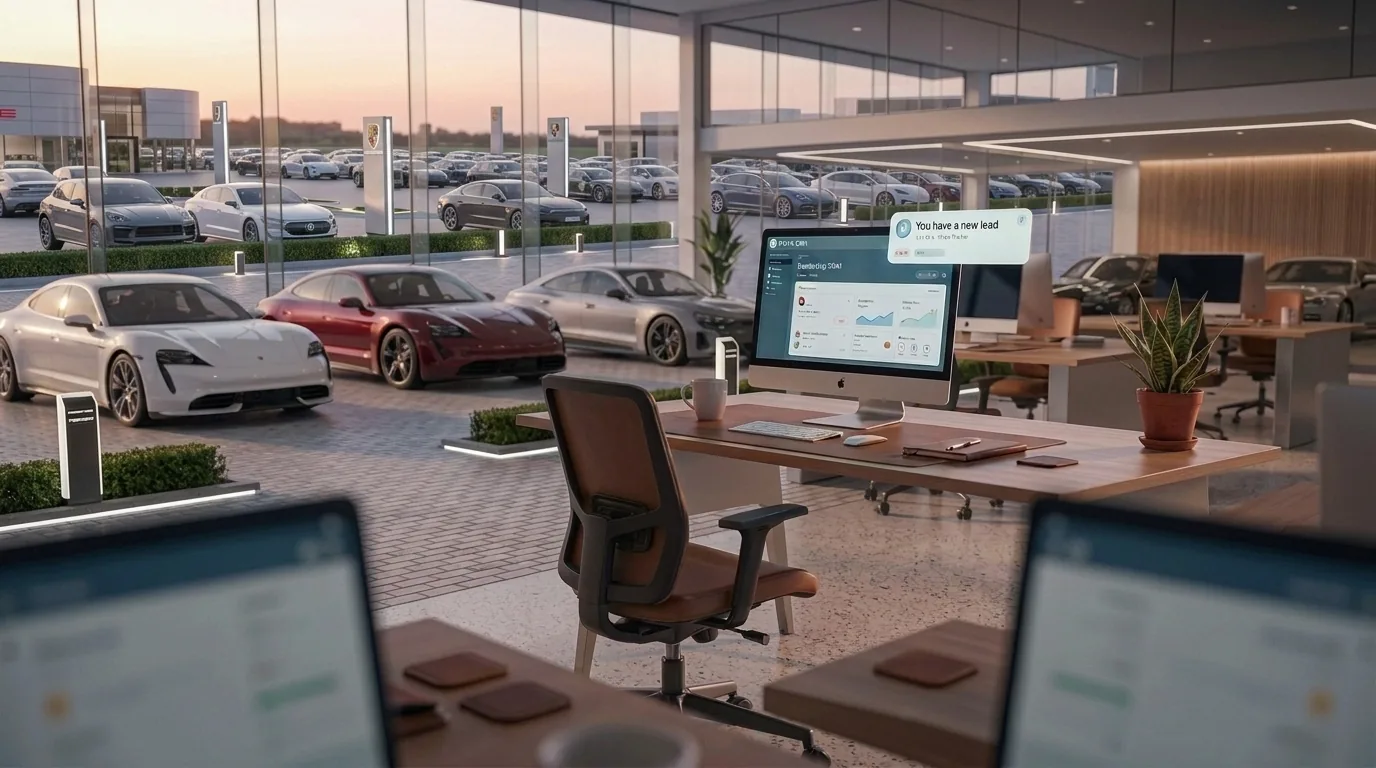
A shopper finds the right used SUV at 11 PM. Price looks fair, mileage is clean, and they submit a lead asking about a test drive. They’re ready.
At most dealerships, that lead sits in the CRM until a BDC rep works the queue the next morning. By then the shopper has heard back from two other stores. Some already have an appointment on the calendar. The store that responds at 9 AM Monday isn’t competing with silence. It’s competing with the store whose system reached the buyer at 11:04 PM Sunday.
At most dealerships, the problem isn’t lead volume. It’s response.
Most of your leads arrive when your store is closed
McKinsey’s January 2025 auto retail analysis puts it plainly: 56% of new dealership leads come in after hours, and only 37% of dealerships address after-hours leads within the first hour (source).
That’s not a rounding error. That’s the majority of your funnel arriving when the lights are off, and even then, most stores don’t get to them fast enough to matter.
Recent independent mystery-shop research reinforces the point. A 2026 study by Clearline AI shopped 53 dealerships and found the average first-response time was over 9 hours; only 13.2% of dealers responded inside the five-minute window that research identifies as the conversion sweet spot (source). Nearly one in three never responded at all inside a five-day tracking window.
Take a second to sit with those two numbers together: 56% of your leads come in after hours, and roughly 13% of dealers can hit a five-minute response even during the day. That’s the shape of the problem.
The speed cliff is real, and it’s steep
The anchor research on lead response is the 2007 MIT / InsideSales.com Lead Response Management Study. It found that reaching a lead within five minutes was roughly 100 times more likely to result in a live connection than reaching them at 30 minutes.
That research is 18 years old. The mechanism is the same today. A shopper submits inquiries to two, three, four dealerships. Whoever calls them first, while they’re still on the website, gets the conversation. Everyone else is a callback.
According to Lead Connect’s speed-to-lead research, 78% of buyers purchase from the business that responds first (via Vendasta). The store that calls Monday morning isn’t just late. It’s the fourth voice in the buyer’s ear on a decision they may have already made.
After-hours leads convert somewhat lower than daytime leads even with a fast response, because they skew earlier-funnel and more casual browsing. But a fast response to an after-hours lead still beats a slow response every single time. The idea that “after-hours leads are bad” mostly reflects that nobody’s working them. They’re not bad. They’re abundant, high-intent, and almost entirely unworked.
Appointment set, and appointment kept
The job of the first touch, in a BDC, isn’t to sell the car. Cars get sold in the showroom. The job of first touch is to earn and lock in the next step: a specific-time appointment with the customer’s calendar committed.
That distinction matters because the metric that predicts revenue isn’t appointment-set rate. It’s show rate. And show rates rise sharply when the appointment is booked at a real time, confirmed by the customer, and reinforced with a reminder, not left as an open-ended “when can you come by?” from a rep on Tuesday morning.
A booked 5:30 PM Wednesday test drive is worth many times more than the same lead sitting in the queue. Everyone in a BDC knows this. What’s changed is that most stores can’t staff a night shift to actually book those appointments in the moment.
The honest case for AI in the BDC
Cars are not sold on the phone. That’s not the argument.
AI voice agents don’t close deals. They don’t replace the salesperson who walks a family around the used lot and finds the right SUV. Systems that try to run the whole sale with no human involvement have been shown to convert worse than a hybrid model, because these buyers want a real person before they commit to spending $30,000.
The argument is much narrower.
At 11 PM, the alternative isn’t a great BDC rep. The alternative is voicemail. That’s the actual comparison. Measured against voicemail, AI does five things that move revenue:
Instant response, around the clock, on the vehicle inquiry that just came in. This includes the 5-to-9 PM rush, the weekend surge, and the Monday-morning stack of overnight leads.
Simultaneous conversations. No hold time. No callers dropping off before someone can get to them.
Booking into the actual scheduler. A specific time, a specific vehicle, confirmed by text, written back to the CRM and DMS so the salesperson walks into a real appointment with real context.
Consistent qualification. Same questions, same script, every time. Your reps aren’t hunting for what the buyer wanted an hour later; the notes are already there.
Coverage without a night shift. One BDC rep effectively supervises more territory because the AI is handling first-touch triage and booking around them, not competing with them.
The model that works is a hybrid. AI owns after-hours first contact and booking. Your people run the showroom, do the negotiation, and close. Your team starts the day with confirmed appointments instead of a stack of cold leads that came in at midnight.
What to actually measure in a pilot
If you’re testing this, don’t measure conversation counts or “AI interactions.” Those are vanity metrics. Measure what connects to revenue:
- After-hours contact rate, split by same-night versus next-morning response.
- Appointment-set rate on after-hours leads specifically.
- Show rate on AI-booked appointments (this is the real test; a booking that doesn’t show up is worse than no booking, because you staffed for it).
- Time-to-first-contact, and the percentage of leads reached inside five minutes.
- Uncontested rate: the leads you reached that competing stores never did.
Bottom line
Most of your leads arrive after the store closes. Buyers go with whoever reaches them first. Only a fraction of dealerships answer inbound leads fast even during business hours. And you can’t staff a night shift cheaply. That last one is structural. Most stores have tried, and the math only works for the largest markets.
An AI BDC doesn’t need to sell the car. It needs to beat voicemail. It needs to respond while the buyer is still shopping, and it needs to set a confirmed appointment before another store does. On appointments set and kept, the data isn’t close.