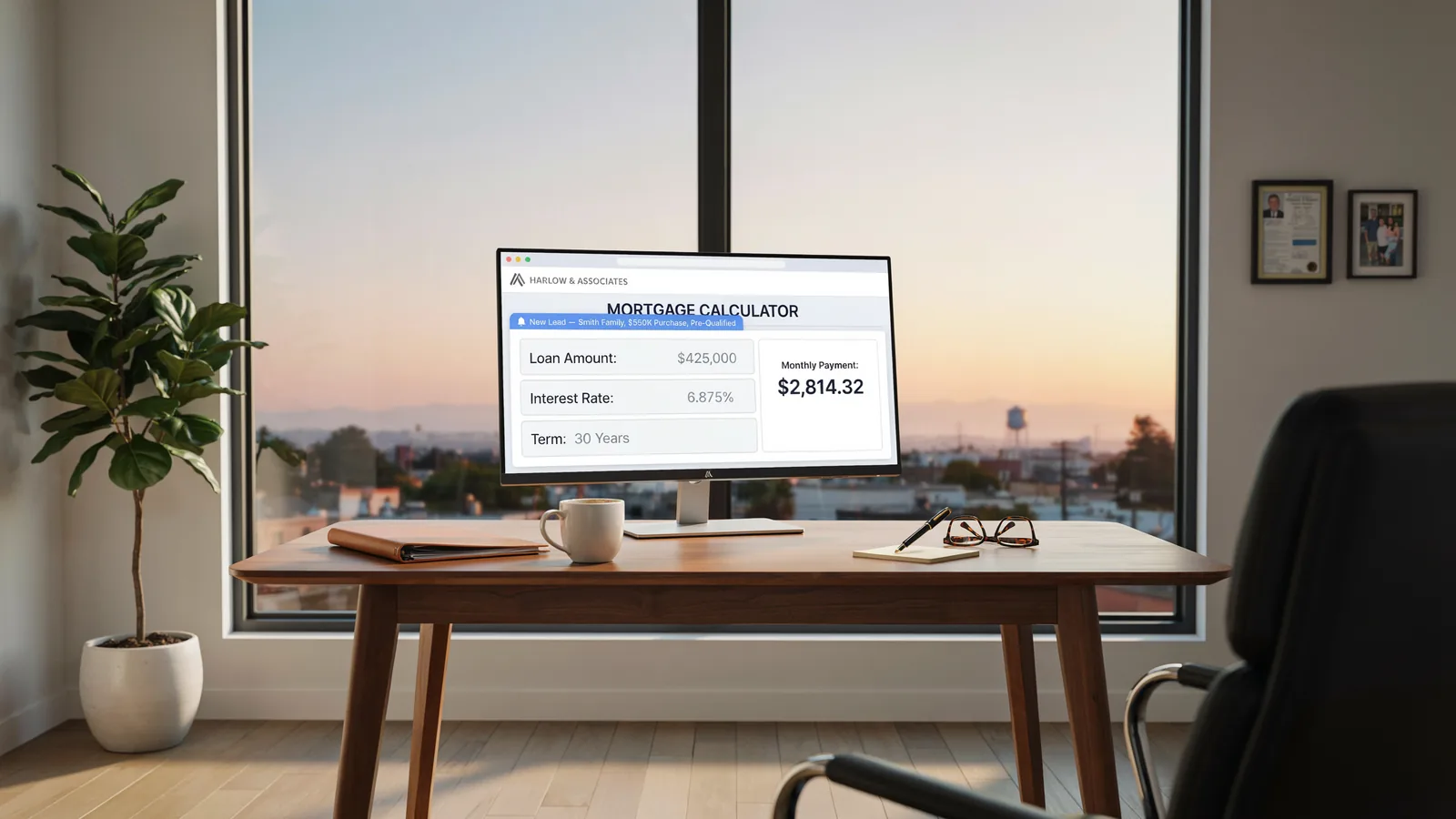
A large share of mortgage leads arrive after hours, yet 40% of new mortgage leads are never contacted at all and average response time runs about 6 hours, per Insellerate research presented at the MBA Annual Conference. Since borrowers routinely shop 3–5 lenders in one session and go with whoever responds first, that delay is a direct, measurable loss in funded loans.
A borrower runs the numbers on a payment calculator at 11:40 PM, sees a monthly payment they can live with, and submits a rate inquiry. Not to one lender. To five.
Within minutes, whoever responds first is having a conversation with a motivated borrower who just decided to buy a house. By the time your loan officer opens the queue at 9 AM, the borrower is already talking to someone else. In some cases, taking the first steps on an application. In some cases, already loose-locked at a competitor’s rate.
In lending, response speed isn’t a nicety. It’s the mechanism that decides who funds the loan. Here’s what the data shows about after-hours mortgage leads, and why an AI that answers instantly and books the consultation is one of the most direct pull-through levers available to a shop that isn’t already doing it.
Mortgage leads don’t keep banker hours
Refinance shoppers run their numbers at night. Purchase borrowers submit inquiries after they finally have time to look, which for most working buyers means evenings and weekends. The consumer data across Zillow, LendingTree, and the direct-to-consumer channel is consistent on this: a large share of inquiries arrive when the phones are quiet.
The response gap on those leads is worse than most operators want to admit. A speed-to-contact study conducted by Insellerate at the MBA Annual Conference found that 40% of new mortgage leads were never contacted at all, fewer than 2% got a call within the first hour, and the average response time landed at roughly 6 hours. That was based on live shopping of participating companies at the conference, not on self-reported surveys.
Even during business hours the picture is uneven. STRATMOR Group, which runs secret-shopping and operational-benchmark work across retail lenders, has commented consistently on the gap between the “assigned LO” model and how many calls actually reach that LO live. When a shopper hits voicemail on the assigned LO, the drop-off is severe. Hiya’s State of the Call report puts voicemail abandonment at roughly 80%, meaning four out of five callers who reach voicemail hang up without leaving a message. Invoca’s platform data puts it higher, at 86%.
For a lender running paid internet leads at $30 to $100 apiece, those numbers translate into paid pipeline that never even reaches the LO.
The speed cliff, and what it costs per funded loan
The foundational research on lead response covered why. The Lead Response Management Study (2007), conducted by Dr. James B. Oldroyd with InsideSales.com, found that reaching a lead within five minutes was roughly 100 times more likely to connect than reaching them at 30 minutes, and roughly 21 times more likely to qualify. The 2011 Harvard Business Review study by Oldroyd, McElheran, and Elkington found that responding to a lead within one hour made a firm 7 times more likely to have a meaningful conversation with a decision-maker than waiting even an hour longer, and 60 times more likely than waiting 24 hours.
Mortgage isn’t a special case. If anything the borrower behavior is more compressed than in other categories because rates move, motivation fades, and borrowers who’ve decided to shop tend to submit to multiple lenders in the same session.
The economics compound quickly. Retail loan officer commissions typically run 50 to 100 basis points on the loan amount, which on the average U.S. residential mortgage puts originator compensation at roughly $2,000 to $4,000 per funded loan. Internet-lead pull-through often sits in the low single digits. At $50 per lead and a 2% pull-through rate, that’s $2,500 in lead cost per funded loan before any comp or overhead. Moving pull-through from 2% to 3% cuts lead cost per funded loan by a third, and speed-to-lead is the most direct lever there is. Anything you can do to reach a higher share of leads before they lock in with another lender flows straight through to CPFL.
First-responder economics are denser in mortgage than almost anywhere
Borrowers routinely submit to three to five lenders in a single session and start receiving calls, texts, and emails within minutes. Research from Xant.ai (formerly InsideSales.com) has consistently shown that 35% to 50% of sales go to the vendor that responds first. In mortgage, where rate differences between competing lenders are often marginal and the borrower doesn’t know what “meaningfully cheaper” looks like on 30 basis points, being first isn’t a nice-to-have. It’s frequently the entire determinant of who funds the loan.
A two-hour delay in that competitive window isn’t a small handicap. It’s often functionally the same as no response at all. The conversation happened. The trust got built. The relationship set. And that’s before you factor in the borrower’s growing motivation to just be done shopping.
The real win is booking the consultation
Reaching the borrower is half of it. The lift comes from turning that live moment into a committed next step. In mortgage, that means a consultation booked with a licensed loan officer at a specific time, before the borrower’s motivation fades or a competitor gets them into an application.
A borrower with a Tuesday 2 PM call on the LO’s calendar is a commitment made at peak intent. A lead sitting in the morning queue with a “left voicemail, will retry” note is a maybe that’s already shopping. Anyone who’s worked internet leads at a retail shop knows which of those two produces the funded-loan report at month-end.
The mechanics are boring but they need to be right. Confirm you have the right person. Ask light qualifying questions (loan purpose, property status, timeline, general credit range). Book the consultation directly into the LO’s calendar. Send a text confirmation with the time and the LO’s name. Log everything to the LOS or CRM so the LO walks into the consultation with real context, not starting from zero.
The case for AI in mortgage, and the compliance guardrails that make it work
Mortgage is a licensed, regulated business, and any technology touching borrower conversations has to sit inside those guardrails. The right division of labor between AI and licensed LO is also the compliant one.
What AI can do after hours: answer within seconds, confirm the borrower’s basic situation, ask light qualifying questions, and book the consultation with a licensed loan officer. Everything gets logged to the CRM and LOS. The borrower gets a text confirmation.
What stays with the licensed human: quoting interest rates, delivering RESPA disclosures and Loan Estimates, and any representation about program eligibility. These are all licensed activities and none of them belong in an AI script. The AI protects the first five minutes so the LO gets the next twenty with an already-qualified, already-informed applicant.
Two compliance notes worth building in from day one, because the regulatory environment shifted in 2026:
The TCPA covers any AI-generated voice call or text going outbound. Marketing outreach requires prior express written consent, plus Do-Not-Call scrubbing. This includes AI making outbound calls to unresponsive leads, calling old pre-approvals, or texting rate updates. Inbound response to a customer-initiated inquiry is treated differently from unsolicited outreach, but the moment your AI is proactively reaching out, the consent regime is non-negotiable. Get the form language and the opt-out flow reviewed by counsel before you flip the switch.
The Homebuyers Privacy Protection Act (HPPA), effective March 5, 2026, amends the Fair Credit Reporting Act to sharply restrict when credit bureaus can sell mortgage credit trigger leads to third-party lenders. Trigger leads can only be sold now where there’s an existing relationship with the consumer or explicit opt-in consent. If your shop’s growth model has been leaning on trigger-lead volume, your after-hours workflow needs to be compliant with the new rules. This is an area where consulting your compliance team is more important than reading a marketing blog.
The argument for AI isn’t that it out-talks your best LO. It doesn’t and it shouldn’t try. The argument is that the after-hours alternative to AI is voicemail, and against voicemail, an agent that answers in 30 seconds and books the licensed consultation wins the borrower before your competitors even know the lead existed.
What to measure in a pilot
If you’re testing an AI voice agent for after-hours mortgage lead response, skip conversation counts and “AI interactions logged.” Those don’t tie to funded loans. Measure what does:
After-hours contact rate, split by same-night versus next-morning response Lead-to-consultation booking rate on AI-handled after-hours leads Show rate on AI-booked consultations (a booking that doesn’t show is worse than no booking, because the LO staffed for it) Time-to-first-contact, and the percentage of leads reached inside five minutes Downstream: application rate and pull-through on AI-handled after-hours leads versus your baseline
Sixty days of that data will tell you whether AI moves your cost-per-funded-loan. Ninety days is better if lead volume is uneven. Anything less is guesswork.
The takeaway
Mortgage borrowers shop late, shop wide, and buy from whoever reaches them first. Loan officers can’t cover midnight and nobody is asking them to. But 40% of new mortgage leads are never contacted at all, and the average response time is six hours. That’s a structural gap, not an execution problem. Closing it doesn’t require changing the rate sheet or the underwriting box. It plugs the leak: answer instantly, qualify, and book the licensed consultation while the borrower is at peak intent.
On cost per funded loan, that’s the highest-return move most retail mortgage shops aren’t yet making.
Sources
- Lead Response Management Study, James Oldroyd (via InsideSales.com), 2007. The original InsideSales.com research microsite is no longer live, but the findings (100× more likely to reach a lead at 5 minutes vs. 30 minutes; 21× more likely to qualify) were incorporated into Dr. Oldroyd’s peer-reviewed Harvard Business Review publication and are widely replicated across secondary research. See the HBR entry below for the peer-reviewed record.
- Oldroyd, J. B., McElheran, K., & Elkington, D. (2011). “The Short Life of Online Sales Leads.” Harvard Business Review, March 2011. Available at: https://hbr.org/2011/03/the-short-life-of-online-sales-leads. Look for: firms contacting a lead within one hour were 7× more likely to have a meaningful conversation with a decision-maker than those waiting an hour longer, and 60× more likely than those waiting 24 hours.
- Insellerate — Speed-to-Contact Research Study, conducted at the MBA Annual Conference, 2024. Findings referenced across mortgage industry publications include: 40% of new mortgage leads were never contacted, fewer than 2% received a call within the first hour, and the average response time was approximately 6 hours. Insellerate is a mortgage CRM and engagement platform. Company site: https://insellerate.com. Findings cited by Magic Blocks, Mortgage Lead Conversion Benchmarks (2026): https://magicblocks.ai/blog/mortgage-lead-conversion-benchmarks. (Note: Insellerate has published multiple speed-to-contact studies dating back to 2015. The 2024 MBA Annual figures cited here are distinct from Insellerate’s earlier 2015 study, which found 56% of companies never responded to inquiries.)
- Xant.ai (formerly InsideSales.com) — Research on first-responder economics: 35% to 50% of sales go to the vendor that responds first. Widely cited across sales research and industry publications. Company site: https://www.xant.ai. Referenced in Email Analytics, 101 Sales Statistics Every Sales Rep Should Know: https://emailanalytics.com/sales-statistics/.
- Hiya — State of the Call report. Look for: approximately 80% of business callers who reach voicemail hang up without leaving a message. Report available at: https://www.hiya.com/state-of-the-call. Corroborated by Invoca platform data, which places the voicemail abandonment rate closer to 86% across service business categories: https://www.invoca.com/blog/how-much-missed-sales-calls-cost-home-services-businesses.
- STRATMOR Group — Mortgage industry advisory firm. Ongoing commentary on retail mortgage operational benchmarks and secret-shopping observations of LO live-answer performance. Underlying data drawn from STRATMOR’s MortgageCX Borrower Satisfaction Program and Secret Shopping Program. Insights and reports library: https://www.stratmorgroup.com/insights. See specifically: Prepare for Takeoff: AI and the Fight for Mortgage Lending Efficiency: https://www.stratmorgroup.com/prepare-for-takeoff-ai-and-the-fight-for-mortgage-lending-efficiency.
- Homebuyers Privacy Protection Act (H.R. 2808), 119th Congress. Signed into law September 5, 2025; effective March 5, 2026. Amends the Fair Credit Reporting Act to sharply restrict when credit reporting agencies may sell mortgage credit trigger leads to third-party lenders. Trigger leads may now only be sold where the lender has an existing relationship with the consumer or where the consumer has expressly opted in. Full text and legislative history: https://www.congress.gov/bill/119th-congress/house-bill/2808.
- U.S. Bureau of Labor Statistics — Occupational Outlook Handbook: Loan Officers. https://www.bls.gov/ooh/business-and-financial/loan-officers.htm. Loan officer compensation data. Cross-referenced with 2025-2026 industry compensation benchmarks: retail loan officer commissions typically run 50 to 100 basis points on the loan amount, producing roughly $2,000 to $4,000 in originator compensation on the average U.S. residential mortgage.