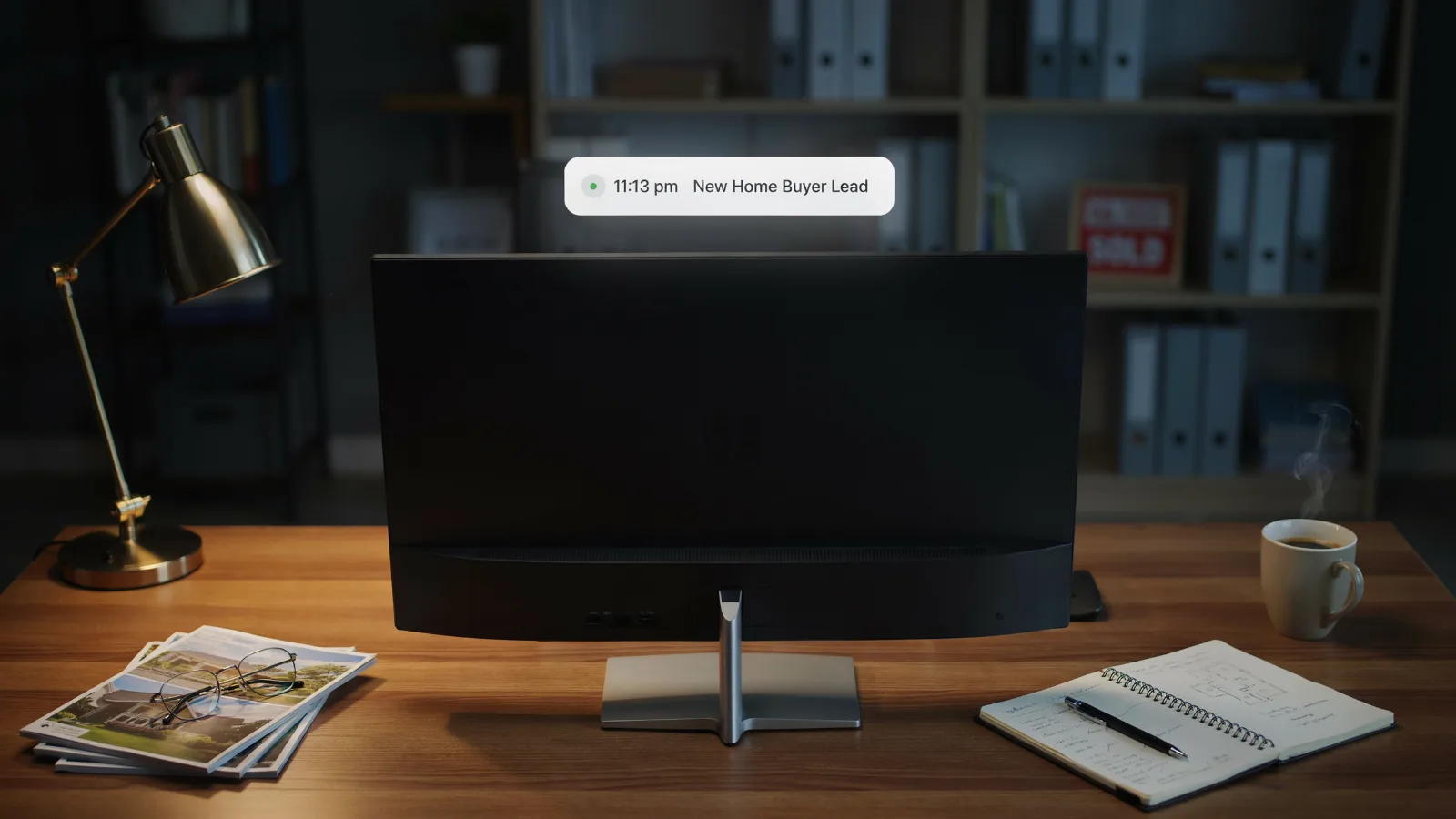
Roughly two-thirds of real estate inquiries arrive after standard business hours, but the average agent takes over 15 hours to respond, according to a WAV Group study of 384 U.S. brokers. Since 78% of buyers work with whichever agent responds first, that gap is the largest, most avoidable source of lost commissions in residential real estate.
A buyer scrolls Zillow after the kids are asleep, finds the one, and at 9:47 PM taps “request a showing.” They’re as motivated as they will ever be. They have researched the rates, looked at their own budget, checked with their partner and hits send.
Then nothing happens.
The agent opens the CRM at 8:03 the next morning, calls back, and the buyer’s already on the phone with someone who answered last night. Saturday tour is booked. The relationship is set. Your agent is now the second call.
This plays out every single evening across every brokerage, and it’s the largest, quietest source of lost commission in the business. Here’s what the data actually shows about after-hours real estate leads, and why an AI that answers the phone and books the showing while the buyer is still on the site is the highest-leverage fix available to a brokerage that isn’t already running one.
A large share of your leads arrive after hours
The data is clearer than most agents want it to be. A large share of real estate inquiries are submitted outside standard business hours, with industry lead-timing data consistently pointing to evenings and weekend afternoons as the peak windows. Those aren’t tire-kickers. Those are buyers who finally have uninterrupted time to look, decide, and reach out.
Response coverage during those hours ranges from thin to nonexistent. A Roof AI 2024 study of the top 74 U.S. brokerages found that 41% failed to respond to online inquiries at all within three days, and only 9% responded within the crucial five-minute window even during business hours. A separate Homeflow audit of sales-inquiry response found 48% went entirely unanswered.
The reason after-hours is worst is structural: no staff, no automation running, no live routing. Leads sit in a CRM queue until someone logs in the next morning. By then the buyer has moved on, in one of a few possible directions, most of them not toward you.
The 15-hour gap most brokerages actually run
The most-cited data point in this category is what agents actually clock as an average response time. The WAV Group / Weichert Real Estate 2014 study of 384 U.S. brokers across 11 states measured this directly. Average response time to a buyer inquiry landed at 917 minutes, more than 15 hours, and nearly half of inquiries never got a response at all. That study is a decade old but the number keeps getting cited because nobody has run one at that scale since, and the operational patterns haven’t materially changed.
Fifteen hours means a lead that comes in Tuesday at 8 PM doesn’t hear back from the average agent until roughly noon Wednesday. By then the buyer has probably reached out to two or three other agents, may already have a showing booked, and has definitely lost the emotional urgency that pushed them to fill out the form in the first place.
Which brings us to the speed cliff.
The speed cliff is unforgiving in real estate
The foundational research on lead response is the Lead Response Management Study (2007), conducted by Dr. James B. Oldroyd with InsideSales.com, which analyzed more than 15,000 web leads and 100,000 call attempts. It found that reaching a lead within five minutes was roughly 100 times more likely to result in a connection than reaching them at 30 minutes, and roughly 21 times more likely to qualify them.
The 2011 Harvard Business Review study by Oldroyd, McElheran, and Elkington added a second layer using data from 2,241 U.S. companies: responding to a lead within one hour made a firm 7 times more likely to have a meaningful conversation with a decision-maker than waiting even one hour longer, and 60 times more likely than waiting 24 hours.
Real estate isn’t a special case. If anything it’s an especially bad category for slow response, because the emotional peak of “I love this house” is fragile in a way that other buying decisions aren’t. A buyer who fills out a showing request at 9:47 PM is at a state of urgency that will not be there at 8:03 AM. Not because the house has changed. Because the buyer has slept, calmed down, and started comparison-shopping.
A 9:47 PM inquiry answered at 8 AM isn’t a quick callback. It’s a delay measured in hours, past several turns of the funnel where the odds fall off a cliff.
Buyers go with whoever answers first
Buyers don’t submit one inquiry and wait. They submit to three or four agents in the same session and go with whoever calls first. According to the NAR 2025 Home Buyers and Sellers Generational Trends Report, roughly 78% of buyers work with the first agent who responds. That’s the whole game. The agent who calls Wednesday at noon isn’t competing against yesterday’s silence. They’re competing against the agent whose system called the buyer at 9:50 PM Tuesday and booked the Saturday tour.
There’s also a psychological dimension worth naming to buyers. Someone who can track a package at 2 AM, rebook a flight at midnight, or get a live customer service chat from their bank on a Sunday doesn’t mentally excuse a 14-hour silence from a real estate professional. They read it as indifference before the relationship even starts. First impression is set, and it isn’t good.
The real win is booking the showing while intent is hot
Reaching the buyer is half of it. What actually matters is turning that live moment into a committed next step: a booked showing or a buyer consultation at a specific time, with a specific agent, on the calendar. Not a “we’ll call you tomorrow.” A calendar hold.
A lead sitting in a morning queue is a maybe. A buyer with a Saturday 11 AM showing on the agent’s calendar is a commitment made at peak intent. Anyone who has run a real estate team knows which of those two produces the closed-deal report at year-end.
The mechanics matter. Confirm the property. Ask light qualifying questions (timeline, financing status, pre-approval, must-haves, price range). Book the showing directly into the agent’s calendar. Send a text confirmation. Log everything to the CRM (Follow Up Boss, Sierra, Boomtown, whatever the brokerage runs) so the agent walks into the showing with real context. That’s it. Nothing fancy.
The case for AI in real estate, without the hype
AI isn’t going to out-negotiate a great agent. It isn’t going to close the deal. It doesn’t build the relationship that produces referrals. That’s not the argument.
The argument is much narrower. At 10 PM on a Saturday, the alternative to AI isn’t your best agent. It’s voicemail. And measured against voicemail, an AI voice agent does five things that move revenue:
Sub-minute response on that 9:47 PM inquiry, every night, every weekend, every holiday.
No missed leads during open houses, showings, listing appointments, or dinner. When you’re with another client, the AI is with this one.
Direct booking. It checks the calendar, sets the showing at a specific time, sends confirmation, and logs the appointment to the CRM before the buyer closes the tab.
Consistent qualification. Same questions, same script, every time. Your agent walks into a scheduled showing already knowing the timeline, the financing status, and the must-haves.
Extends coverage without extra headcount. One ISA can effectively supervise more territory because the AI handles first-touch triage and booking around them, not competing with them.
The model that works is a hybrid. AI owns first contact and booking after hours. Your agents run the tour, do the negotiation, close the deal. Your team starts the day with tours already on the calendar, not a list of cold overnight leads that toured with someone else.
What to measure if you run a pilot
If you’re testing an AI voice agent for after-hours real estate lead response, skip vanity metrics like “conversations logged.” Measure what connects to closed transactions:
After-hours contact rate, split by same-night versus next-morning response Lead-to-showing (or consultation) booking rate on after-hours leads specifically Show rate on AI-booked appointments (a booking that doesn’t show is worse than no booking, because the agent staffed for it) Time-to-first-contact, and percentage of after-hours leads reached inside five minutes Uncontested rate: after-hours buyers your AI reached that competing agents never did (this is your strongest metric in real estate, and most brokerages never measure it)
Sixty days of that data will tell you whether an AI voice agent moves the needle for your brokerage. Anything less is guesswork.
The takeaway
A large share of real estate leads arrive when the office is closed. The average agent takes 15 hours to respond. Buyers go with whoever reaches them first, and if you’re not the first call, you’re mostly not any of the calls. That’s a structural gap, not an effort problem.
Agents can’t reasonably cover 10 PM on a Saturday. Nobody expects them to. But an AI voice agent doesn’t need to out-sell a great agent. It needs to beat voicemail, respond while the buyer is still on the site, and book the showing before another agent does. On that scorecard, the data isn’t close.
Sources
- Lead Response Management Study, James Oldroyd (via InsideSales.com), 2007. Peer-reviewed anchor for speed-to-lead research: 100 times more likely to connect at 5 minutes vs. 30 minutes; 21 times more likely to qualify. Findings incorporated into the peer-reviewed HBR publication below.
- Oldroyd, J. B., McElheran, K., & Elkington, D. (2011). “The Short Life of Online Sales Leads.” Harvard Business Review, March 2011. Available at: https://hbr.org/2011/03/the-short-life-of-online-sales-leads. Look for: firms contacting a lead within one hour were 7x more likely to have a meaningful conversation with a decision-maker than those waiting an hour longer, and 60x more likely than those waiting 24 hours.
- National Association of Realtors (2025). Home Buyers and Sellers Generational Trends Report. Available at: https://www.nar.realtor/research-and-statistics/research-reports/home-buyer-and-seller-generational-trends. Look for: 78% of buyers work with the first agent who responds.
- WAV Group / Weichert Real Estate (2014). Agent Responsiveness Study. Measured response rates across 384 U.S. brokers in 11 states. Average response time to buyer inquiries: 917 minutes (over 15 hours); 48% of inquiries received no response at all. WAV Group: https://wavgroup.com. The 917-minute figure is often incorrectly attributed in secondary sources to more recent Inman or NAR surveys.
- Roof AI (2024). Top 74 U.S. Brokerages Lead Response Study. 41% of top brokerages failed to respond to online inquiries within three days; 9% responded within five minutes. Roof AI is a real estate-focused AI response tool; the study should be treated as vendor research and cross-referenced against WAV Group and Homeflow data where available.
- Homeflow. Independent audit of real estate sales inquiry response rates. Found 48% of sales inquiries went entirely unanswered.